- From 6 October–5 November 2026 (5 Weeks, 10 Classes, 20 Total Hours)
- Every Tuesday and Thursday at 1–3 p.m. ET (all sessions will be recorded and available for replay; course notes will be available for download)
- AIAA’s new essential course on Electric Propulsion Diagnostics is taught by world-leading experts from the AIAA Electric Propulsion Technical Committee with decades of combined research and teaching experience.
- All students will receive an AIAA Certificate of Completion at the end of the course.
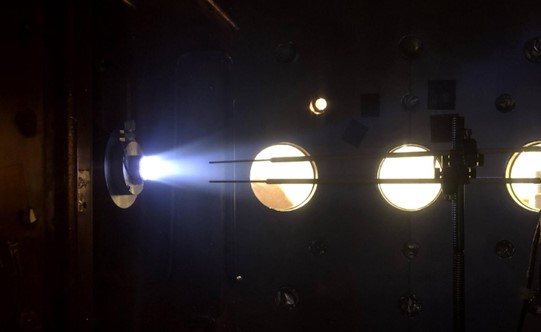
OVERVIEW
This 20-hour online course, instructed by experts from
AIAA’s Electric Propulsion Technical Committee, will introduce participants to
modern methods for measuring the behavior of electric thrusters for spacecraft
propulsion. The course will provide a comprehensive understanding of the
theoretical and practical aspects of different probe and optical diagnostic
methods. Lecturers will provide examples of how these methods are currently
utilized by academia, government, and industry to advance the performance and
reliability of electric propulsion systems.
LEARNING OBJECTIVES
- Awareness of testing needs for electric propulsion research and development (EP R&D)
- Knowledge of performance and lifetime requirements for electric thrusters
- Comprehensive understanding of the different types of measurements used in EP R&D
- Understanding of theory and practical design of thrust stands for electric thruster performance characterization
- Understanding of theory and practical design of electric probes for thruster plasma characterization
- Understanding of theory and practical design of laser diagnostics for non-intrusive measurements and thruster model calibration
- Understanding of optical emission spectroscopy for thruster characterization
- Understanding the role of mass spectroscopy and quartz crystal microbalance techniques
- Understanding of thrust erosion measurements, state-of-health diagnostics, and the use of diagnostics to improve models for thruster lifetime predictions
AUDIENCE
The
course is designed for project engineers, researchers, students, scientists,
and managers engaged in research, design, development, and testing of
spacecraft electric propulsion systems.
COURSE
FEES (Sign-In To Register)
-
AIAA Member Price: $945 USD
-
AIAA Student Member Price: $495 USD
- Non-Member Price: $1,145 USD
------------------------------------------------------------------------------------------------------------
OUTLINE
- Introduction
to Electric Propulsion Research and Development (Prof. Little)
Overview of modern challenges in electric propulsion, the role of research and development in the present and near future, motivation for thruster and plasma diagnostics, examples of how diagnostics have been used to successfully advance spacecraft electric propulsion. - Thrust Stands for
Direct Performance Characterization (Prof. Gilpin)
Overview of common direct thrust measurement techniques for electric propulsion, their applicability, advantages and disadvantages. Best practices for experimental design and data collection. Common sources of measurement uncertainty and design for noise reduction. - Langmuir Probes for Measuring Thruster Plasma Parameters
(Prof. Lemmer)
Overview of Langmuir probes, and the physics necessary for understanding how they work and how to analyze data. Understanding assumptions necessary to process LP data. Equations to analyze LP data. Sample LP data and a demonstration of how to analyze the data. - Retarding Potential Energy
Analyzers for Beam Energy Characterization (Prof. Lemmer)
Overview of retarding potential energy analyzers for ion beam characterization in electric propulsion systems. Fundamental equations to analyze RPA data. Application of RPAs to time-dependent ion beam measurements. Sample data and a demonstration of how to analyze the data. - E x B Probes for Ion Velocity and Ionization State
Measurements (Prof. Rovey)
Overview of current practices and approaches to the design, fabrication, and implementation of the ExB probe in EP testing. Review of theory and modelling of ExB probe physics, current practices and approaches to ExB probe data collection, analysis, and interpretation. Specific examples of these aspects of ExB use in EP testing are described with specific examples of ExB use in the two most dominant types of EP systems today: gridded ion thrusters and Hall-effect thrusters. - Laser-Induced Fluorescence for Ion Energy Distribution
Functions (Prof. Jorns)
Overview of key principles governing laser induced fluorescence for xenon and krypton. Experimental setup and equipment. Analysis techniques for spectra and discussion of broadening and de-convolution methods. Overview of how this data is employed in the field. - Laser Thomson Scattering for Temperature and Wave
Measurements (Prof. Tsikata)
Overview of key principles governing Thomson scattering. Experimental configurations used and key considerations and constraints related to setup design and optimization. Recovery of information from scattered spectra. Information regarding physical interpretations and insights which may be gained from such implementations. - Optical Emission Spectroscopy in Electric Propulsion
(Prof. Underwood)
Overview of emission spectroscopy and its application to diagnose electric propulsion systems. Topics will include the fundamentals of line shapes, line positions, and line strengths in plasma spectroscopy. Applications will be given to measuring rotational temperatures, vibrational temperatures, and free electron densities in plumes. Software tools to perform spectroscopic fits to molecular transitions and electronic transitions within atomic propellants will be described. A short description of collisional radiative models, and their relationship to optical emission spectra, will be described. - Mass Spectrometry and Quartz Crystal Microbalances (Prof.
Petro)
Overview of the use of mass spectrometers (TOF-MS and quadrupole) and quartz crystal microbalances (QCMs) for electric propulsion testing. These instruments are useful for measuring plume composition, characterizing deposition and erosion processes and contamination effects in thruster testing environments. Practical considerations for integrating these diagnostics into EP vacuum test facilities and analyzing results to assess thruster performance and lifetime are also discussed. - Erosion Measurements and Thruster Health Diagnostics (Dr.
Lobbia)
Overview of best practices for characterizing thruster erosion and wear over long test periods. Discussion of thruster lifetime characterization challenges and current approaches to predicting thruster lifetime. Introduction to state-of-health diagnostics for laboratory testing and in situ.
INSTRUCTORS
Prof. Matthew Gilpin is an Associate Professor of Aerospace and Mechanical Engineering (AME) Practice at the University of Southern California. Since 2022, he has been the principal investigator for USC’s In-Space Propulsion Research (InSPR) laboratory focusing on novel diagnostic solutions for advanced spacecraft propulsion. Dr. Gilpin has worked closely with the AFRL for over 15 years where his research has focused on thrust measurement, transient flow characterization, and in-situ specific impulse measurements for microthrusters. Prior to forming the InSPR laboratory at USC, Dr. Gilpin worked as a consultant designing and delivering multiple thrust measurement systems to industry partners including Aerojet Rocketdyne, MOOG, Inc. and Lockheed Martin. In addition to his current work with InSPR, Dr. Gilpin is the faculty advisor to the Advanced Spacecraft Propulsion and Energy (ASPEN) laboratory at USC which is a student-led group dedicated to giving all interested undergraduate students hands-on experience in electric propulsion. ASPEN students have successfully presented their work at IEPC, and the group continues to grow with increasing industry and University sponsorship. Dr. Gilpin is also the advisor to USC’s ASME Recumbent Vehicle Design Team, and he teaches AME’s undergraduate lab series in test, measurement and experimentation. Dr. Gilpin received his Ph.D. from USC in 2015 for his experimental studies of solar thermal propulsion. He was awarded the William F. Ballhaus Jr. prize for excellence in graduate engineering research and was recognized as an ARCS scholar.
Prof. Benjamin Jorns, an associate professor in the Department of Aerospace Engineering at the University of Michigan where he co-directs the Plasmadynamics and Electric Propulsion Laboratory. Founded in 1992, this lab is one of the largest and oldest in the country dedicated to in-space propulsion research. Dr. Jorns received his B.S. in Physics from Yale (2007) and his M.A. and Ph.D. degrees in Aerospace Engineering from Princeton (2012). Prior to joining the faculty at the University of Michigan (2017), Dr. Jorns was a member of the electric propulsion group at the NASA Jet Propulsion Laboratory (JPL) in Pasadena, California from 2012-2016 where his work combined experimental and analytical techniques to investigate propulsion systems for the next generation of NASA robotic missions. Dr. Jorns also held a lecturer appointment in the Mechanical and Aerospace Engineering department at UCLA from 2013-2015. His primary research interests include wear mechanisms and stability in electric propulsion systems, turbulence and nonlinear processes in low temperature plasmas, developing new plasma diagnostics, and investigating breakthrough forms of in-space propulsion. Dr. Jorns has published over 150 journal articles and conference proceedings in the field, and he has been recognized six times with the “Best Paper” work in electric propulsion from AIAA. He is an associate fellow of the AIAA and member of the IEEE, APS, and Electric Rocket Propulsion Society. He is also the recipient of the AFOSR Young Investigator Program award, the DOE Early Career Award, the AIAA Sperry Award, and seven NASA technical achievement awards. He has held several leadership roles for the AIAA’s Electric Propulsion Technical Committee including serving most recently as a Technical Discipline Chair for the AIAA SciTech.
Prof. Kristina Lemmer, a professor in Western Michigan University's Department of Mechanical and Aerospace Engineering. After joining WMU in 2012, she founded WMU's Aerospace Laboratory for Plasma Experiments (ALPE) and the Western Aerospace Launch Initiative (WALI). As the faculty mentor for WALI, Lemmer guides students through the satellite design, build, and test. A prolific researcher, she has received numerous awards, including a Young Investigator Program Award from the U.S. Air Force Office of Scientific Research, the 2021 WMU Emerging Scholar Award for the most promising young researcher and the 2024 WMU Distinguished Scholar Award. She has received over $4.5 million in external funding, and her research is funded by the Air Force Office of Scientific Research, National Science Foundation, Air Force Research Laboratory, NASA, and the Michigan Space Grant Consortium. Lemmer received her Ph.D. from the University of Michigan in aerospace engineering specializing in plasma dynamics and electric spacecraft propulsion. She is on the board of directors for the Electric Rocket Propulsion Society and serves as the chair for the Electric Propulsion Technical Committee of the American Institute of Aeronautics and Astronautics (AIAA). Dr. Lemmer is an associate fellow in AIAA.
Prof. Justin Little, an Associate Professor in the William E. Boeing Department of Aeronautics & Astronautics at the University of Washington. He received a BS in Physics and Aerospace engineering from the University of California, Irvine, and a PhD in Mechanical & Aerospace Engineering from Princeton University. Prof. Little’s research focuses on understanding how low-temperature plasma physics influence the performance and design of emerging electric propulsion technologies. His research methods emphasize a close relationship between reduced-order theoretical modeling and innovative experiment design to explore the fundamental scaling of dominant physics. He is a National Defense Science and Engineering Graduate Fellow, a recipient of the AFOSR Young Investigator Program award, and a recipient of the DARPA Young Faculty Award.
Dr. Robert Lobbia, a Staff Engineer in the Electric Propulsion Group at NASA’s Jet Propulsion Laboratory (JPL), where he specializes in the development and testing of advanced propulsion systems for deep-space exploration. Since joining JPL in 2016, he has led key experimental test campaigns for the HERMeS Hall thruster and the 12.5 kW Advanced Electric Propulsion System (AEPS), which are critical to the Power and Propulsion Element of NASA's Lunar Gateway. An expert in plasma diagnostics and thruster wear testing, Dr. Lobbia previously served as an engineer at the Air Force Research Laboratory (AFRL), where he focused on on-orbit propulsion operations and analysis. He holds a Ph.D. and M.S. in Aerospace Engineering from the University of Michigan, along with dual bachelor's degrees in Physics and Aerospace Engineering from UCLA.
Prof. Elaine Petro joined the Cornell University faculty as an Assistant Professor in the Sibley School of Mechanical and Aerospace Engineering at in 2020. She is the director of the newly formed ASTRAlab, which focuses on plasma science and sustainable space exploration architectures. Elaine did her graduate work at the University of Maryland’s Space Power and Propulsion Laboratory studying water plasma propulsion. She also spent time in the MIT Department of Aeronautics and Astronautics as a visiting student and post-doctoral researcher, studying electrospray thruster technology for small satellite platforms. Elaine has been named an ARCS Scholar, National Science Foundation and Amelia Earhart fellow, and was recognized as one of AIAA / Aviation Week & Space Technology’s Twenty20s emerging leaders in aerospace in 2016. Prior to graduate studies at UMD, Petro worked on the MAVEN Mars Orbiter, and James Webb Space Telescope, and Hubble Space Telescope missions at NASA’s Goddard Space Flight Center. Elaine participated in the 2015 NASA/Caltech Jet Propulsion Laboratory Planetary Science Summer School (PSSS) on the THEO concept mission to Enceladus, an icy moon of Saturn. Elaine is passionate about diversity and inclusion in STEM and is a founding member of the national Women of Aeronautics and Astronautics organization, now an active committee within the AIAA Integration and Outreach Division.
Prof. Joshua Rovey, a professor at the University of Illinois Urbana-Champaign who has worked in the space propulsion area for over 23 years having published almost 150 journal and conference papers in this area. He is director of the electric propulsion laboratory, and his research interests include carbon contamination in high-power thruster testing, embedded sensing and diagnostics for EP thrusters, multimode propulsion and novel alternative propellants. He received PhD from the University of Michigan, and was a propulsion research engineer for a small business, and professor at Missouri S&T. He is recipient of numerous awards including Air Force Young Investigator, NASA Innovative Advanced Concepts Fellow, AIAA Sperry award, and Illinois Teaching Excellence award. He is an AIAA Associate Fellow.
Prof. Sedina Tsikata, associate professor at Georgia Tech and holder of a Lewis Professorship. Dr. Tsikata's research interests are the fundamental nature and applications of magnetized plasmas, with a focus on the development of advanced diagnostics, analysis methods, control, and new plasma devices. Her research has been applied to first-time, non-invasive detection of key instabilities and measurement of electron features in Hall plasma thrusters using Thomson scattering, and characterization of other magnetized plasma environments relevant to materials processing and accelerator physics. Prior to joining Georgia Tech in 2023, Dr. Tsikata was a researcher with the CNRS (the National Center for Scientific Research) in France. Dr. Tsikata received graduate degrees from the Ecole Polytechnique in France, and a bachelor's degree from the Massachusetts Institute of Technology. Her research has received recognitions which include Best Paper Awards from the International Electric Propulsion Conference (2019, 2024), the 2019 AIAA Electric Propulsion Outstanding Technical Achievement Award, the CNRS Bronze Medal, and William Crookes Award. She is an Associate Fellow of the AIAA.
Prof. Thomas Underwood, an assistant professor in the Department of Aerospace Engineering and Engineering Mechanics at the University of Texas at Austin. Dr. Underwood’s research is focused on plasma chemistry and electric propulsion. His primary focus in on experimentally investigating how partially ionized and non-equilibrium flows can be applied to enable new technologies. He received his Ph.D. in mechanical engineering from Stanford University. As a graduate student, Underwood engineered new methods to visualize and stabilize hydromagnetic plasma jets. During his postdoctoral research at Harvard University, Underwood explored applications of reactive chemistry. Underwood’s research has been recognized with several awards, including the 2021 AFOSR Young Investigator Award and 2024 NASA Early Career Faculty.
CLASSROOM HOURS / CEUs: 20 classroom hours / 2.0 CEU/PDH
COURSE DELIVERY AND MATERIALS
- The course lectures will be delivered via Zoom. Access to the Zoom classroom will be provided to registrants near to the course start date.
- All sessions will be available on-demand within 1-2 days of the lecture. Once available, you can stream the replay video anytime, 24/7.
- All slides will be available for download after each lecture. No part of these materials may be reproduced, distributed, or transmitted, unless for course participants. All rights reserved.
- Between lectures during the course, the instructor(s) will be available via email for technical questions and comments.
Cancellation Policy: A refund less a $50.00 cancellation fee will be assessed for all cancellations made in writing prior to 5 days before the start of the event. After that time, no refunds will be provided.
Contact: Please contact Lisa Le or Customer Service if you have any questions about the course or group discounts.